Event-Driven Architecture at Scale: Outbox, Idempotency, and Kafka

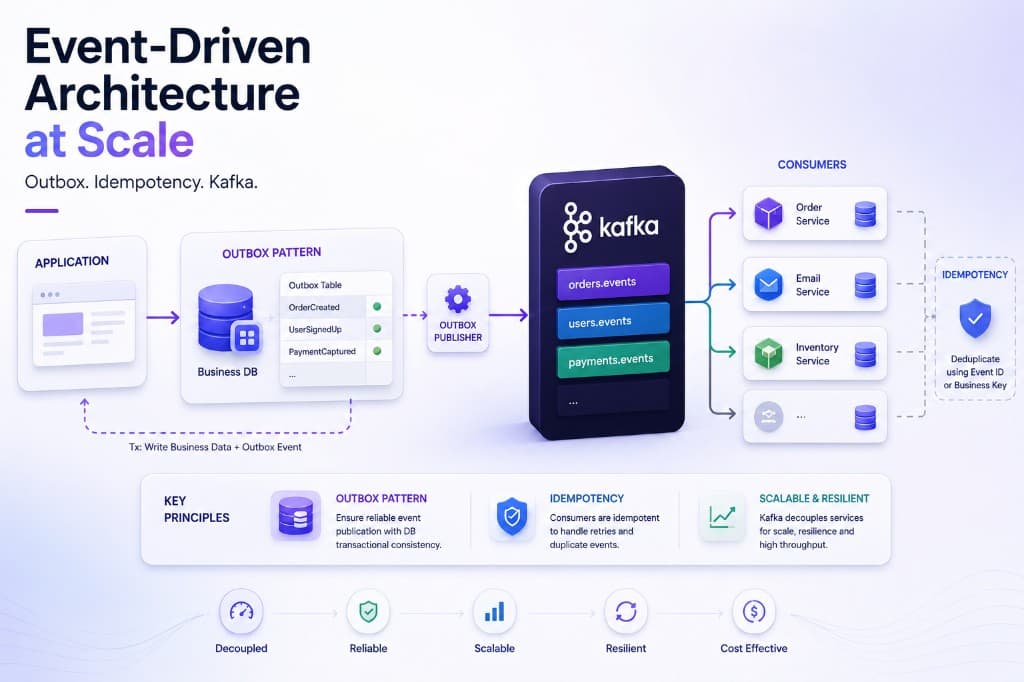
How we design pub/sub systems, outbox patterns, and idempotent consumers so message storms do not become outages during peak traffic.
Events are contracts, not logs
Teams adopt Kafka hoping for decoupling and get distributed debugging instead. The difference is contract discipline: versioned schemas, explicit ownership, and clear delivery semantics. An event storm without schemas is just a more expensive way to couple services through tribal knowledge.
We define producers, consumers, and SLOs per topic. If nobody owns poison messages, peak traffic will invent an owner at the worst time.
Include product in lag playbooks. Users need honest delay messaging when consumers pause — silence creates support load and duplicate submissions.
Transactional outbox over dual writes
Writing to the database and then publishing to a broker is a classic consistency trap. The outbox pattern records the event in the same transaction as business state, then a relay publishes safely.
This pattern survives broker outages and process crashes. It also makes replay and audit trails honest because the source of truth for "what happened" stays with the domain data.
Include product in lag playbooks. Users need honest delay messaging when consumers pause — silence creates support load and duplicate submissions.
Idempotent consumers and backpressure
At least-once delivery means duplicates will happen. Consumers must key on event IDs or natural business keys and treat retries as normal. Side effects — emails, charges, provisioned resources — need dedupe tables or provider idempotency keys.
Backpressure matters as much as throughput. Consumer lag alerts should trigger load shedding or buffer expansion before partitions fall hours behind and create cascading retries.
Include product in lag playbooks. Users need honest delay messaging when consumers pause — silence creates support load and duplicate submissions.
Peak traffic playbooks
Load tests should include producer bursts, consumer slowdowns, and poison pill scenarios. We rehearse pausing consumers, draining DLQs, and replaying from offsets with product awareness of user-visible delay.
Event-driven systems that survive peaks are boring: strong schemas, outboxes, idempotency, and operators who have practised failure — not just drawn boxes on a whiteboard.
Include product in lag playbooks. Users need honest delay messaging when consumers pause — silence creates support load and duplicate submissions.
Rehearse poison pills and lag
Load-test producer bursts, slow consumers, and poison messages. Practise pausing consumers, draining DLQs, and replaying with product awareness of user-visible delay.
Event-driven architecture survives peaks when schemas, outboxes, and idempotency are boring — and operators have rehearsed failure.
Include product in lag playbooks. Users need honest delay messaging when consumers pause — silence creates support load and duplicate submissions.
Version events like public APIs
Teams adopt Kafka hoping for decoupling and get distributed debugging instead. The difference is contract discipline: versioned schemas, explicit ownership, and clear delivery semantics.
Define producers, consumers, and SLOs per topic. If nobody owns poison messages, peak traffic invents an owner at the worst time.
Include product in lag playbooks. Users need honest delay messaging when consumers pause — silence creates support load and duplicate submissions.
Prefer transactional outbox over dual writes
Writing to the database and then publishing to a broker is a classic consistency trap. The outbox records the event in the same transaction as business state; a relay publishes safely afterward.
This pattern survives broker outages and process crashes, and it keeps “what happened” honest for audit and replay.
Include product in lag playbooks. Users need honest delay messaging when consumers pause — silence creates support load and duplicate submissions.
Design consumers for duplicates and lag
At-least-once delivery means duplicates will happen. Key on event IDs or natural business keys. Side effects need dedupe tables or provider idempotency keys.
Alert on consumer lag before partitions fall hours behind. Backpressure and load shedding beat heroic catch-up scripts during incidents.
Include product in lag playbooks. Users need honest delay messaging when consumers pause — silence creates support load and duplicate submissions.
“Sustainable delivery comes from making the important trade-offs explicit, measurable, and recoverable.”
Checklist
- User-facing SLO and baseline captured
- Critical path traced end to end
- Data and dependency ownership documented
- Degraded behavior covered by tests
- Rollout and rollback plan reviewed
- Regression signal monitored after release
Umar Khalid
Software Engineering Manager
Manages day-to-day software engineering across APIs, web UI, and AI features — focused on reliable, maintainable production systems clients can own.
Let's build something
remarkable
Whether you need a web or mobile app with AI integrations, blockchain work, or a conversation about our AI products — tell us what you're building and we'll respond fast.
Blog questions
How we write, how often we publish, and how you can contribute or stay in the loop.
Blogs are written by Automative Tech’s engineering leadership — Muhammad Talha Zubair, Bilal Hassan, and Umar Khalid — based on production web, mobile, AI integration, and blockchain work.
We lead with custom web and mobile delivery with AI integrations — Next.js, React, React Native, Flutter, and LLM features. Selected posts also cover blockchain, AI products, and cloud when they support shipping real products.
A few deep pieces per month. We prioritize substance over cadence.
Yes with attribution and a link back to the original. For syndication, contact us for a simple agreement.
Occasionally, when the author has real production experience. Pitch a short outline via the contact form.
Follow the social links in the footer, or contact us to ask about engineering notes updates.