TypeScript Monorepo Best Practices for Fast CI

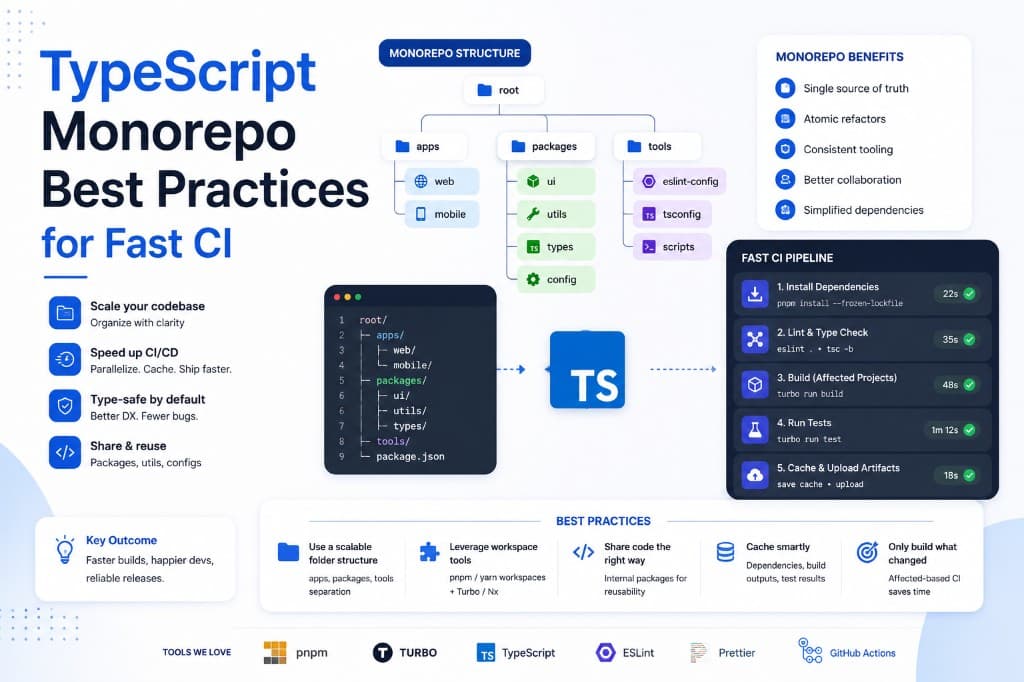
Project references, incremental builds, and package boundaries that keep CI under ten minutes as your TypeScript codebase grows.
Boundaries beat folders
A monorepo without package boundaries is a single app with extra path aliases. Clear packages — UI, domain, API clients, config — let TypeScript project references and build tools compute a real dependency graph.
Enforce dependency rules so apps cannot import each other's internals. Structure is what keeps incremental builds honest.
Assign a rotating owner for workspace upgrades and dependency bumps. Unowned monorepos rot into distributed monoliths with worse tooling.
Project references and incremental typecheck
Enable project references and composite builds so unchanged packages are not rechecked from scratch. Pair with a workspace tool that understands the graph for task caching.
Watch for accidental any leaks and wide path mappings that defeat isolation. Fast typechecking depends on localised change sets.
Assign a rotating owner for workspace upgrades and dependency bumps. Unowned monorepos rot into distributed monoliths with worse tooling.
CI under ten minutes
Cache dependencies and build outputs keyed by lockfile and package hashes. Run affected tests only when the graph says a package changed. Parallelise lint and typecheck where safe.
When CI creeps past your budget, profile which tasks invalidate most often — usually a root config or shared package with too many dependents.
Assign a rotating owner for workspace upgrades and dependency bumps. Unowned monorepos rot into distributed monoliths with worse tooling.
Developer experience as a product
Local workflows should mirror CI enough to avoid surprise failures, but stay lighter. Generators for new packages prevent snowflake setups.
A monorepo that stays fast is curated continuously. Neglect turns it into a distributed monolith with worse tooling.
Assign a rotating owner for workspace upgrades and dependency bumps. Unowned monorepos rot into distributed monoliths with worse tooling.
Profile CI when it creeps
When CI crosses your time budget, profile which packages invalidate most often — usually a root config or an overly shared package. Fix the graph before adding more caching theatre.
A TypeScript monorepo stays fast only while someone owns boundaries, affected tests, and upgrade cadence.
Assign a rotating owner for workspace upgrades and dependency bumps. Unowned monorepos rot into distributed monoliths with worse tooling.
Enforce package boundaries in CI
A monorepo without dependency rules is a single app with extra folders. Use lint rules or architecture tests so apps cannot import each other’s internals, and so UI packages cannot reach the database layer directly.
Clear packages — UI, domain, API clients, config — let TypeScript project references and task runners compute an honest graph. Structure is what keeps incremental builds real.
Assign a rotating owner for workspace upgrades and dependency bumps. Unowned monorepos rot into distributed monoliths with worse tooling.
Cache the graph, not the whole repo blindly
Key CI caches by lockfile and package hashes. Run affected tests only when the graph says a package changed. Parallelise lint and typecheck where safe.
When CI creeps past budget, profile invalidations. Root tsconfig tweaks and “shared utils” barrels with too many dependents are usual suspects.
Assign a rotating owner for workspace upgrades and dependency bumps. Unowned monorepos rot into distributed monoliths with worse tooling.
Generate new packages instead of copying
Snowflake package setups create weeks of silent drift. Provide a generator for new libraries and apps with the same lint, test, and export conventions.
Local workflows should mirror CI enough to avoid surprise failures, but stay lighter for day-to-day coding. Treat developer experience as a product with owners.
Assign a rotating owner for workspace upgrades and dependency bumps. Unowned monorepos rot into distributed monoliths with worse tooling.
“Sustainable delivery comes from making the important trade-offs explicit, measurable, and recoverable.”
Checklist
- User-facing SLO and baseline captured
- Critical path traced end to end
- Data and dependency ownership documented
- Degraded behavior covered by tests
- Rollout and rollback plan reviewed
- Regression signal monitored after release
Umar Khalid
Software Engineering Manager
Manages day-to-day software engineering across APIs, web UI, and AI features — focused on reliable, maintainable production systems clients can own.


Let's build something
remarkable
Whether you need a web or mobile app with AI integrations, blockchain work, or a conversation about our AI products — tell us what you're building and we'll respond fast.
Blog questions
How we write, how often we publish, and how you can contribute or stay in the loop.
Blogs are written by Automative Tech’s engineering leadership — Muhammad Talha Zubair, Bilal Hassan, and Umar Khalid — based on production web, mobile, AI integration, and blockchain work.
We lead with custom web and mobile delivery with AI integrations — Next.js, React, React Native, Flutter, and LLM features. Selected posts also cover blockchain, AI products, and cloud when they support shipping real products.
A few deep pieces per month. We prioritize substance over cadence.
Yes with attribution and a link back to the original. For syndication, contact us for a simple agreement.
Occasionally, when the author has real production experience. Pitch a short outline via the contact form.
Follow the social links in the footer, or contact us to ask about engineering notes updates.