Fine-Tuning vs Prompt Engineering vs RAG: Decision Framework

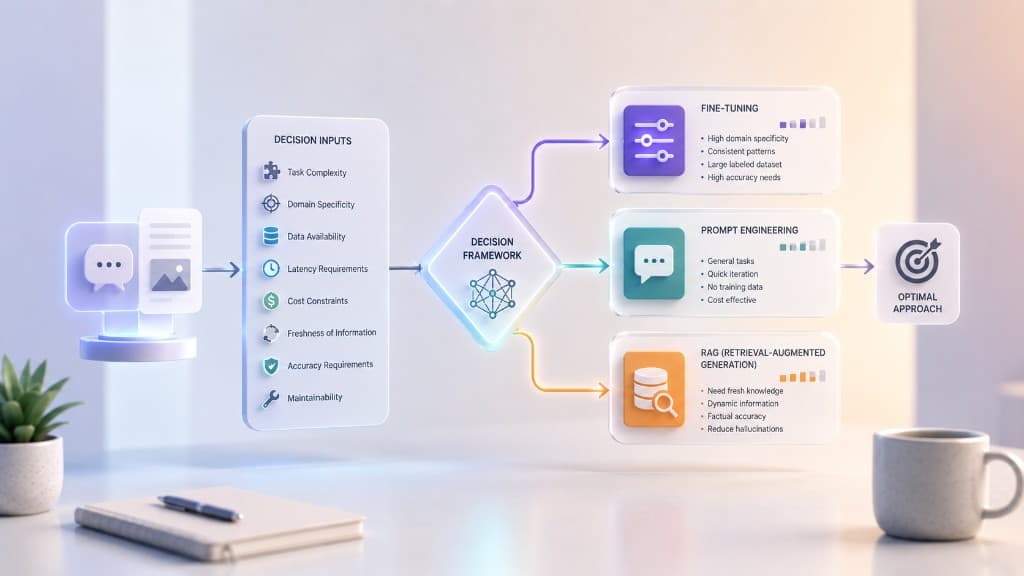
When to stay with prompts, when to fine-tune, and when retrieval alone is enough — based on cost, latency, data quality, and ops burden.
Start with the failure mode
If the model lacks facts about your business, retrieve them. If it misunderstands instructions or format, improve prompts and tools. If it consistently misses a narrow style or classification boundary despite good prompts and data in context, fine-tuning enters the conversation.
Misdiagnosing the failure mode is how teams fine-tune their way into a maintenance burden they did not need.
Compare fine-tunes against a strong prompted baseline on the same golden set. Lift against a weak baseline is not evidence.
When prompting and RAG win
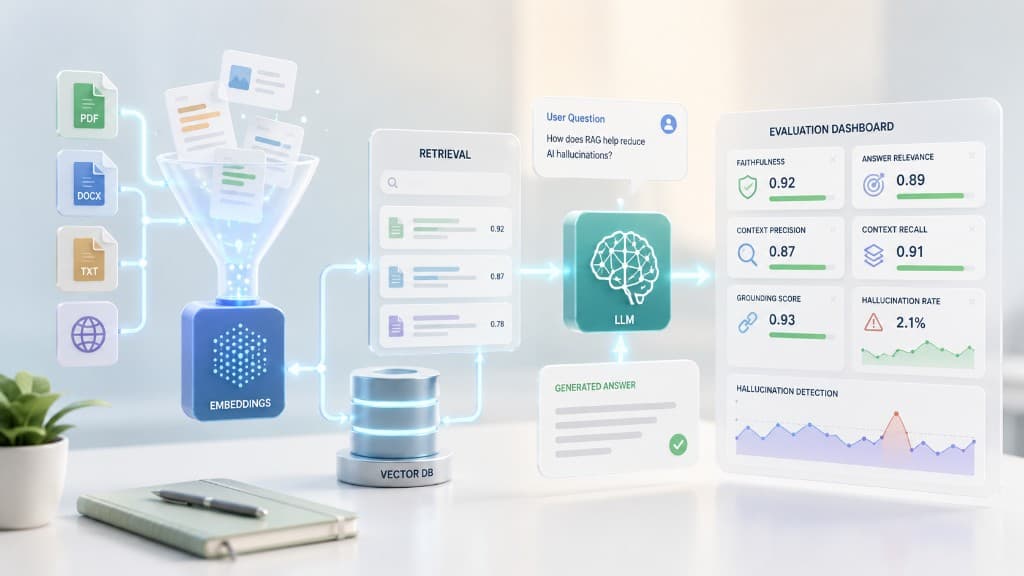
Prompting plus retrieval wins for changing knowledge, enterprise permissions, and rapid iteration. You can update documents without retraining, and you can audit what context was used for an answer.
Latency and cost stay predictable when you control context size. For many products, this stack never needs a custom model.
Compare fine-tunes against a strong prompted baseline on the same golden set. Lift against a weak baseline is not evidence.
When fine-tuning earns its keep
Fine-tune for stable tasks with abundant high-quality labels: routing, extraction schemas, tone constraints, or domain shorthand that wastes tokens in prompts. Measure lift against a strong prompted baseline, not against a weak one.
Budget for evaluation and retraining as product language evolves. A fine-tuned model is a living dependency.
Compare fine-tunes against a strong prompted baseline on the same golden set. Lift against a weak baseline is not evidence.
A practical decision tree
Ask: Is knowledge dynamic? Prefer RAG. Is the issue instruction-following? Prefer prompts and structured outputs. Is the task narrow, stable, and high-volume enough to amortise training? Consider fine-tuning.
Document the choice and revisit quarterly. The right answer in June may be wrong after a model upgrade that improves base prompting dramatically.
Compare fine-tunes against a strong prompted baseline on the same golden set. Lift against a weak baseline is not evidence.
Revisit decisions as models change
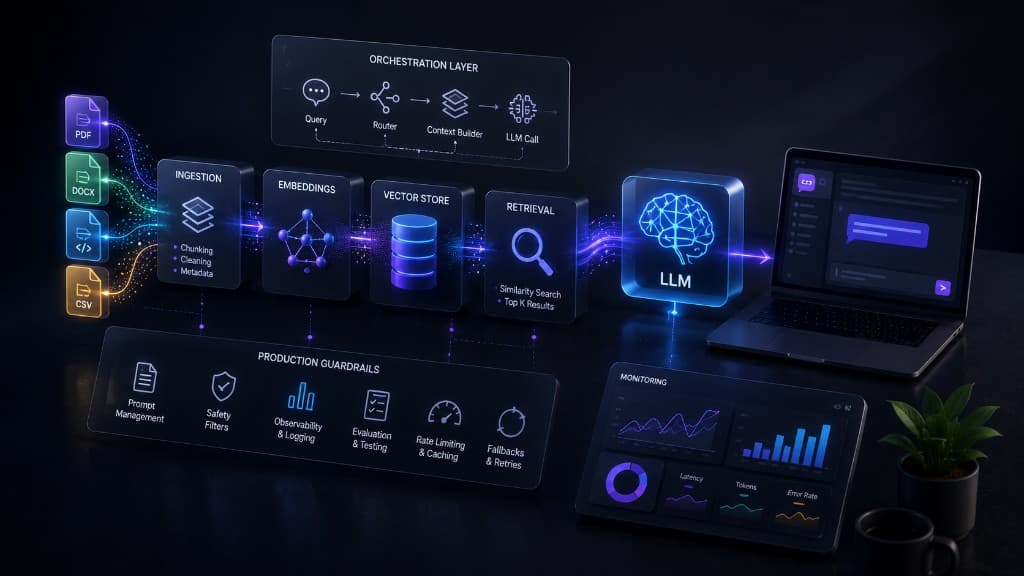
Release AI capabilities behind a controllable boundary. Start with internal users or a small tenant cohort, publish an obvious feedback route, and monitor latency, cost, refusal rate, citation coverage, and escalation rate together. A lower cost answer is not a win if it makes agents reopen work later. Set rate limits and monthly budgets before demand grows, preserve a non-AI workflow, and give support a way to report harmful output with context. Production readiness is reached when an on-call engineer can identify what happened, disable the risky path, and return the user to a useful outcome without waiting on the model provider.
Production AI needs a product contract that survives imperfect inputs and changing providers. Define the user decision, the approved data sources, the freshness rule, and the action boundary before tuning a prompt. Keep an example set drawn from real requests, including vague questions, missing context, sensitive data, and attempts to reach another tenant. Review failures by layer: source content, retrieval, instructions, tool execution, or presentation. That diagnosis prevents a cosmetic prompt change from hiding an authorization or data-quality defect. Release gradually, keep a non-AI path available, and make feedback attach to a trace rather than an anonymous thumbs-down. Monitor cost, time to first token, grounded citation rate, refusal quality, and escalation rate together. A feature is operationally ready when the team can explain the answer, reproduce the context, cap spend, disable a risky capability, and still give the customer a useful next step.
For an AI roadmap, make the operating model visible to the whole product team. Product should own the user outcome and refusal experience; engineering should own the data boundary, service reliability, and measurable quality gates; support should own the escalation route; and security should approve the information class before it reaches a provider. Review a small sample of traces on a cadence, including successful answers, expensive answers, and failures. Version prompts, retrieval settings, and tool schemas so an incident can be reproduced rather than discussed from memory. When a source changes, assess retrieval and citations before shipping it. When a provider changes, rerun the same golden tasks. This discipline creates a feedback loop in which AI capability becomes more useful with use instead of becoming an opaque feature that is too risky to improve.
Compare fine-tunes against a strong prompted baseline on the same golden set. Lift against a weak baseline is not evidence.
Revisit the choice after model upgrades
Document why you chose prompts, RAG, or fine-tuning, then revisit after major base-model upgrades. A fine-tune that was necessary last quarter may be unnecessary after a stronger prompted baseline.
Prefer the option with the lowest maintenance burden that still clears your eval bar — that is usually retrieval and prompts until evidence says otherwise.
Compare fine-tunes against a strong prompted baseline on the same golden set. Lift against a weak baseline is not evidence.
Exhaust prompts and RAG before gradients
Most production quality gaps are retrieval misses, weak instructions, or missing tools — not a model that needs more training. Fine-tune when format and domain voice remain unstable despite strong prompts and context.
Compare fine-tunes against a strong prompted baseline on the same golden set. Lift against a weak baseline is not evidence.
“Sustainable delivery comes from making the important trade-offs explicit, measurable, and recoverable.”
Checklist
- Named user workflow and allowed actions documented
- Representative golden set includes ambiguity and refusal cases
- Retrieval, model, and tool traces linked by request ID
- Tenant permissions enforced outside the prompt
- Cost, latency, and escalation thresholds monitored
- Kill switch and useful fallback tested
Muhammad Talha Zubair
CTO & Managing Director
Owns technical direction and delivery across web, mobile, and AI integration work. Sets architecture standards and keeps product engineering close to the builders.
Let's build something
remarkable
Whether you need a web or mobile app with AI integrations, blockchain work, or a conversation about our AI products — tell us what you're building and we'll respond fast.
Blog questions
How we write, how often we publish, and how you can contribute or stay in the loop.
Blogs are written by Automative Tech’s engineering leadership — Muhammad Talha Zubair, Bilal Hassan, and Umar Khalid — based on production web, mobile, AI integration, and blockchain work.
We lead with custom web and mobile delivery with AI integrations — Next.js, React, React Native, Flutter, and LLM features. Selected posts also cover blockchain, AI products, and cloud when they support shipping real products.
A few deep pieces per month. We prioritize substance over cadence.
Yes with attribution and a link back to the original. For syndication, contact us for a simple agreement.
Occasionally, when the author has real production experience. Pitch a short outline via the contact form.
Follow the social links in the footer, or contact us to ask about engineering notes updates.