The Engineering Firm's Approach to Product Discovery

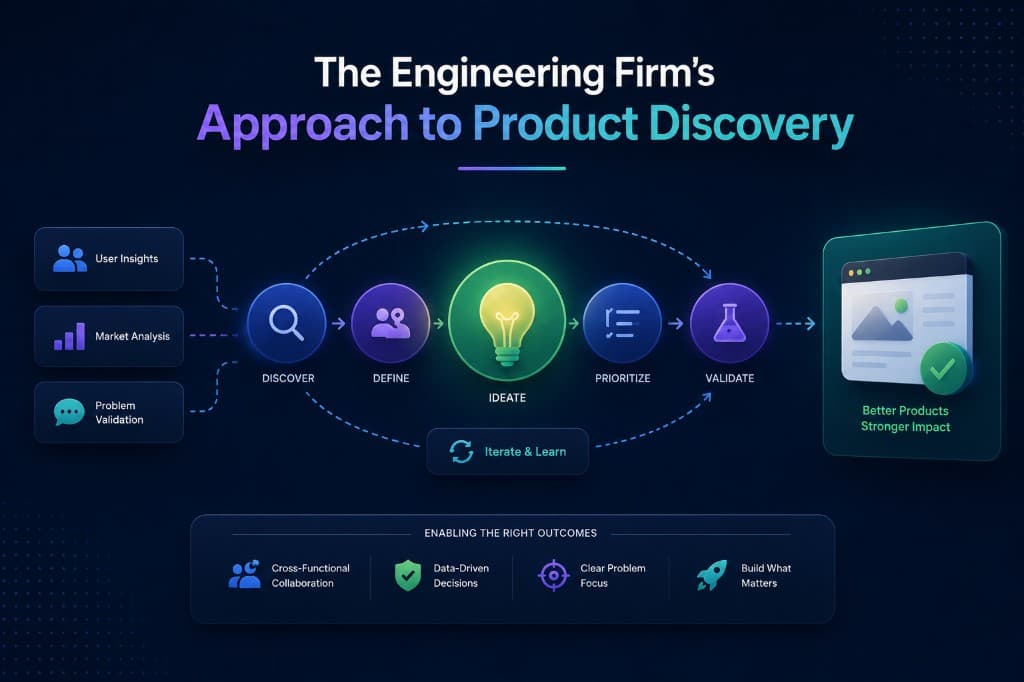
How we blend technical feasibility with user desirability early in the product lifecycle — before a single line of code is written — so custom builds solve the right problem.
Discovery before the backlog
Most failed products did not fail at sprint three — they failed because the problem was never validated with the people who would pay for it. In an engineering firm, the temptation is to jump into architecture because that is where we are strongest. Discovery exists to protect that strength from being spent on the wrong problem.
We treat discovery as a time-boxed workstream with the same discipline as a build phase: owners, artefacts, and exit criteria. The goal is not endless workshops. It is a shared decision that a problem is worth solving, for a defined buyer, under constraints we can actually ship against.
Time-box discovery with exit criteria the same way you time-box a sprint. Endless workshops without a shippable decision are a different kind of waste.
Triangulating desirability, feasibility, and viability
Every discovery engagement maps three lenses. Desirability comes from interviews, shadowing, and job-to-be-done framing. Feasibility comes from spike work, constraint mapping, and an honest look at data readiness. Viability asks who buys, how budget is approved, and what switching costs look like.
When one lens is weak, we do not paper over it with optimism. A delightful workflow that requires unavailable data is not a roadmap item — it is a research debt ticket. Product and engineering co-own that call so nobody feels overruled later when scope changes.
Time-box discovery with exit criteria the same way you time-box a sprint. Endless workshops without a shippable decision are a different kind of waste.
Artefacts that survive the handoff
The output of discovery is not a slide deck that dies in email. We produce problem statements, opportunity scores, technical risk notes, and a thin prototype or clickable flow when it clarifies debate. Those artefacts become the north star for the first delivery increment.
We also document what we chose not to build. Explicit non-goals prevent scope creep when a stakeholder rediscovers an idea three months later. Discovery that leaves decisions undocumented forces the build team to rediscover politics under deadline pressure.
Time-box discovery with exit criteria the same way you time-box a sprint. Endless workshops without a shippable decision are a different kind of waste.
From insight to first slice
A successful discovery ends with a first vertical slice that can learn in production: one persona, one critical workflow, measurable success criteria. We resist platform-first builds that delay contact with reality.
Engineering estimates during this phase are ranges with confidence labels, not false precision. That honesty keeps commercial conversations grounded and makes it easier to re-plan when discovery uncovers a harder integration than expected.
Time-box discovery with exit criteria the same way you time-box a sprint. Endless workshops without a shippable decision are a different kind of waste.
End discovery with a shippable slice
Discovery succeeds when it produces a first vertical slice: one persona, one workflow, measurable success criteria, and explicit non-goals. Anything less is a workshop with leftovers.
That is how Automative Tech keeps custom software discovery tied to delivery instead of slide decks.
Time-box discovery with exit criteria the same way you time-box a sprint. Endless workshops without a shippable decision are a different kind of waste.
Triangulate desirability, feasibility, and viability
Desirability comes from interviews and job-to-be-done framing. Feasibility comes from spikes and data readiness. Viability asks who buys and how budget is approved.
When one lens is weak, do not paper over it with optimism. A delightful workflow that requires unavailable data is research debt, not a roadmap item.
Time-box discovery with exit criteria the same way you time-box a sprint. Endless workshops without a shippable decision are a different kind of waste.
Produce artefacts that survive handoff
The output of discovery is not a slide deck that dies in email. Ship problem statements, opportunity scores, technical risk notes, and explicit non-goals.
Those artefacts become the north star for the first delivery increment and prevent rediscovering politics under deadline pressure.
Time-box discovery with exit criteria the same way you time-box a sprint. Endless workshops without a shippable decision are a different kind of waste.
“Sustainable delivery comes from making the important trade-offs explicit, measurable, and recoverable.”
Checklist
- Buyer problem and current workaround evidenced
- First release metric and non-goals agreed
- Highest-risk assumption tested early
- Decision record names an accountable owner
- Staged launch cohort selected
- Qualitative and quantitative feedback reviewed
Bilal Hassan
CEO & Founder
Founder leading company strategy, client relationships, and growth. Keeps engagements aligned with business outcomes so technical work stays tied to what clients need to ship.


Let's build something
remarkable
Whether you need a web or mobile app with AI integrations, blockchain work, or a conversation about our AI products — tell us what you're building and we'll respond fast.
Blog questions
How we write, how often we publish, and how you can contribute or stay in the loop.
Blogs are written by Automative Tech’s engineering leadership — Muhammad Talha Zubair, Bilal Hassan, and Umar Khalid — based on production web, mobile, AI integration, and blockchain work.
We lead with custom web and mobile delivery with AI integrations — Next.js, React, React Native, Flutter, and LLM features. Selected posts also cover blockchain, AI products, and cloud when they support shipping real products.
A few deep pieces per month. We prioritize substance over cadence.
Yes with attribution and a link back to the original. For syndication, contact us for a simple agreement.
Occasionally, when the author has real production experience. Pitch a short outline via the contact form.
Follow the social links in the footer, or contact us to ask about engineering notes updates.