B2B SaaS Pricing Page Best Practices That Convert

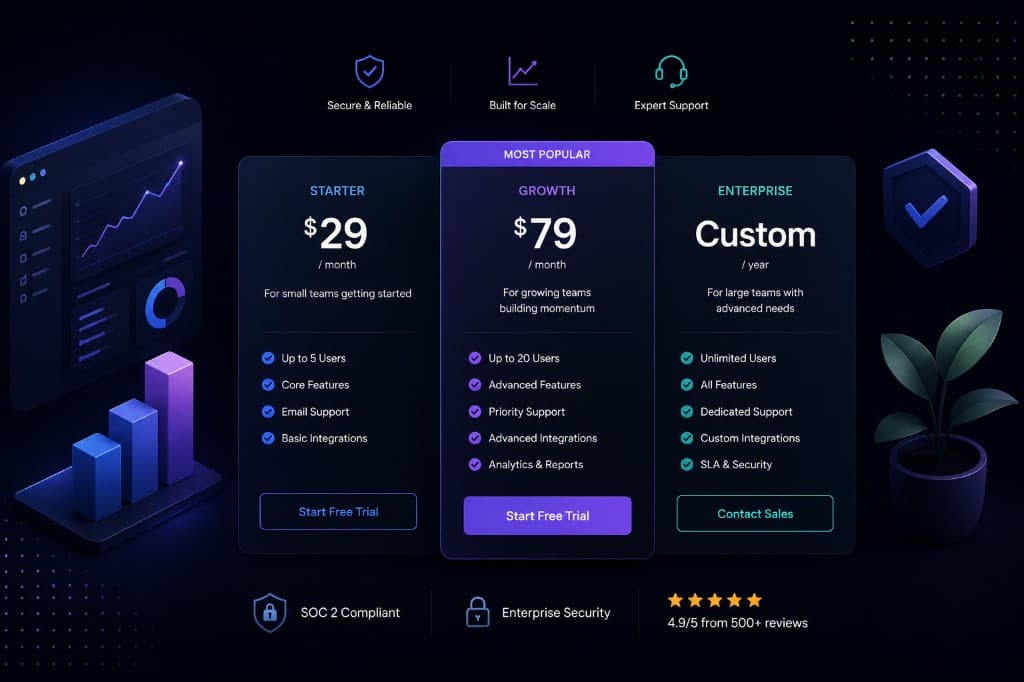
Packaging, tier psychology, and the engineering behind interactive calculators that sales teams actually trust — and buyers convert on.
Packaging before pixels
A pricing page cannot fix confused packaging. Name tiers by outcomes buyers recognise, not by internal SKU history. Good-better-best only works when the middle tier is the honest recommendation for most customers.
Align sales decks and the public page. When numbers disagree, trust collapses and demos become discount negotiations.
Share win/loss notes from sales with the team that owns the public pricing page. Packaging experiments without commercial feedback become design theatre.
Tier psychology without tricks
Highlight the recommended plan, show annual savings clearly, and keep feature comparisons scannable. Dark patterns that hide limits create churn and angry renewals.
Enterprise CTAs should route to conversations with context — company size, usage estimate — so sales does not restart discovery from zero.
Share win/loss notes from sales with the team that owns the public pricing page. Packaging experiments without commercial feedback become design theatre.
Calculators sales can trust
Interactive calculators must use the same rules engine as quoting tools. A marketing-only formula that diverges from Salesforce quotes trains buyers to distrust your site.
Engineer calculators as a shared package with tests. Product marketing owns copy; pricing ops owns the rules; engineering owns correctness.
Share win/loss notes from sales with the team that owns the public pricing page. Packaging experiments without commercial feedback become design theatre.
Measure the whole funnel
Track plan clicks, calculator completions, and sales-accepted opportunity rate — not just page bounce. A beautiful page that generates unqualified demos is not converting.
Iterate packaging with win/loss notes. Pricing pages are product surfaces; treat experiments with the same rigor as feature launches.
Share win/loss notes from sales with the team that owns the public pricing page. Packaging experiments without commercial feedback become design theatre.
Measure sales-accepted opportunities
Track plan clicks and calculator completions alongside sales-accepted opportunity rate. A beautiful pricing page that generates unqualified demos is not converting.
Keep the public calculator on the same rules engine as quoting tools so buyers and sales never negotiate from two realities.
Share win/loss notes from sales with the team that owns the public pricing page. Packaging experiments without commercial feedback become design theatre.
Name tiers by outcomes buyers recognise
A pricing page cannot fix confused packaging. Good-better-best only works when the middle tier is the honest recommendation for most customers.
Align sales decks and the public page. When numbers disagree, trust collapses and demos become discount negotiations.
Share win/loss notes from sales with the team that owns the public pricing page. Packaging experiments without commercial feedback become design theatre.
“Sustainable delivery comes from making the important trade-offs explicit, measurable, and recoverable.”
Checklist
- Buyer problem and current workaround evidenced
- First release metric and non-goals agreed
- Highest-risk assumption tested early
- Decision record names an accountable owner
- Staged launch cohort selected
- Qualitative and quantitative feedback reviewed
Bilal Hassan
CEO & Founder
Founder leading company strategy, client relationships, and growth. Keeps engagements aligned with business outcomes so technical work stays tied to what clients need to ship.



Let's build something
remarkable
Whether you need a web or mobile app with AI integrations, blockchain work, or a conversation about our AI products — tell us what you're building and we'll respond fast.
Blog questions
How we write, how often we publish, and how you can contribute or stay in the loop.
Blogs are written by Automative Tech’s engineering leadership — Muhammad Talha Zubair, Bilal Hassan, and Umar Khalid — based on production web, mobile, AI integration, and blockchain work.
We lead with custom web and mobile delivery with AI integrations — Next.js, React, React Native, Flutter, and LLM features. Selected posts also cover blockchain, AI products, and cloud when they support shipping real products.
A few deep pieces per month. We prioritize substance over cadence.
Yes with attribution and a link back to the original. For syndication, contact us for a simple agreement.
Occasionally, when the author has real production experience. Pitch a short outline via the contact form.
Follow the social links in the footer, or contact us to ask about engineering notes updates.