Feature Flag Best Practices for Growing SaaS Products

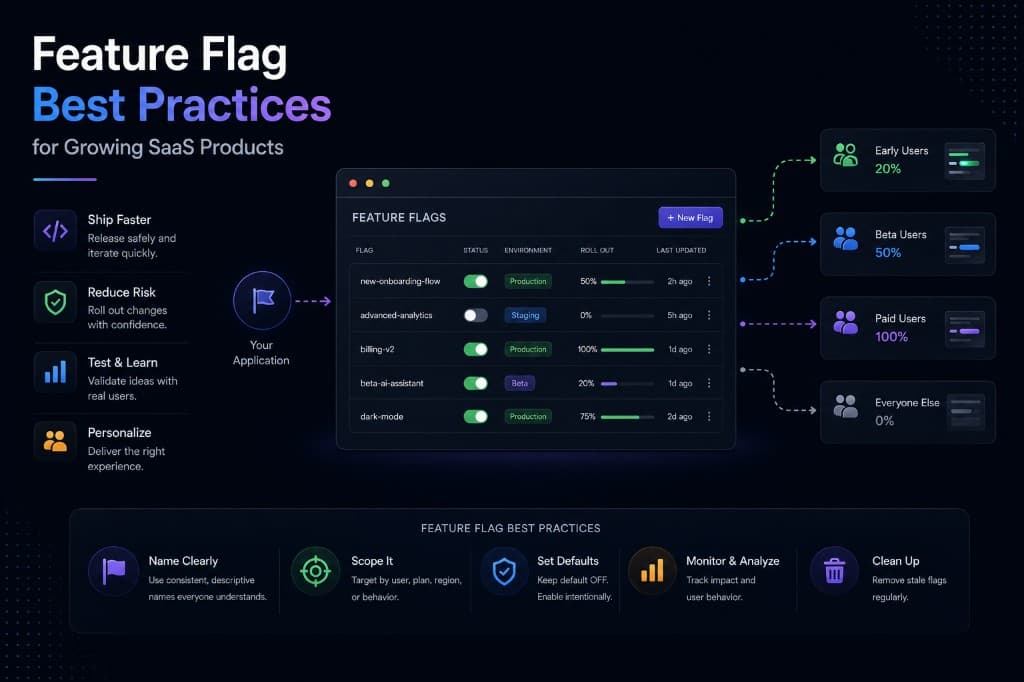
Governance, kill switches, and experiment hygiene so feature flags accelerate delivery instead of becoming permanent configuration debt.
Flags are a product surface
Feature flags accelerate delivery until they become an undocumented second configuration language. At enterprise scale, every flag needs an owner, expiry expectation, and purpose: release, experiment, or ops kill switch.
Without taxonomy, teams reuse temporary flags for permanent behaviour and the combinatorial state space becomes untestable.
Publish a weekly stale-flag report to engineering managers. Visibility alone clears more debt than another platform migration.
Governance that teams accept
Lightweight rules beat heavy committees. Require a ticket link, default state, and cleanup date on flag creation. Automate stale-flag reports into sprint hygiene.
Security-sensitive flags — those that expose data or admin tools — need stronger change control than a marketing copy experiment.
Publish a weekly stale-flag report to engineering managers. Visibility alone clears more debt than another platform migration.
Kill switches and blast radius
Ops flags should fail closed or open intentionally, with runbook steps. The point of a kill switch is minutes-to-mitigation, not a debate about root cause during an incident.
Test kill switches in staging. An untested flag is a placebo.
Publish a weekly stale-flag report to engineering managers. Visibility alone clears more debt than another platform migration.
Experiment hygiene
Experiments need hypotheses, metrics, and end states. Shipping both variants forever is not experimentation — it is abandonment.
When a winner is chosen, remove the loser path promptly. Flag debt compounds interest faster than most technical backlog items.
Publish a weekly stale-flag report to engineering managers. Visibility alone clears more debt than another platform migration.
Expire flags on purpose
Require an owner, purpose (release, experiment, kill switch), and cleanup date on every flag. Automate stale-flag reports into sprint hygiene.
Feature flags accelerate SaaS delivery only while the combinatorial state space stays testable.
Publish a weekly stale-flag report to engineering managers. Visibility alone clears more debt than another platform migration.
Taxonomy before tooling
Every flag needs a purpose: release, experiment, or ops kill switch. Without taxonomy, teams reuse temporary flags for permanent behaviour and the state space becomes untestable.
Lightweight rules beat heavy committees: ticket link, default state, cleanup date, and stronger change control for security-sensitive flags.
Publish a weekly stale-flag report to engineering managers. Visibility alone clears more debt than another platform migration.
Test kill switches in staging
Ops flags should fail closed or open intentionally, with runbook steps. Minutes-to-mitigation is the point — not a debate during an incident.
An untested kill switch is a placebo. Rehearse it before you need it.
Publish a weekly stale-flag report to engineering managers. Visibility alone clears more debt than another platform migration.
Remove losers promptly
Experiments need hypotheses, metrics, and end states. Shipping both variants forever is abandonment, not experimentation.
When a winner is chosen, delete the loser path. Flag debt compounds faster than most backlog items.
Publish a weekly stale-flag report to engineering managers. Visibility alone clears more debt than another platform migration.
“Sustainable delivery comes from making the important trade-offs explicit, measurable, and recoverable.”
Checklist
- Buyer problem and current workaround evidenced
- First release metric and non-goals agreed
- Highest-risk assumption tested early
- Decision record names an accountable owner
- Staged launch cohort selected
- Qualitative and quantitative feedback reviewed
Bilal Hassan
CEO & Founder
Founder leading company strategy, client relationships, and growth. Keeps engagements aligned with business outcomes so technical work stays tied to what clients need to ship.



Let's build something
remarkable
Whether you need a web or mobile app with AI integrations, blockchain work, or a conversation about our AI products — tell us what you're building and we'll respond fast.
Blog questions
How we write, how often we publish, and how you can contribute or stay in the loop.
Blogs are written by Automative Tech’s engineering leadership — Muhammad Talha Zubair, Bilal Hassan, and Umar Khalid — based on production web, mobile, AI integration, and blockchain work.
We lead with custom web and mobile delivery with AI integrations — Next.js, React, React Native, Flutter, and LLM features. Selected posts also cover blockchain, AI products, and cloud when they support shipping real products.
A few deep pieces per month. We prioritize substance over cadence.
Yes with attribution and a link back to the original. For syndication, contact us for a simple agreement.
Occasionally, when the author has real production experience. Pitch a short outline via the contact form.
Follow the social links in the footer, or contact us to ask about engineering notes updates.