How to Build a Secure DeFi Lending Protocol with Solidity

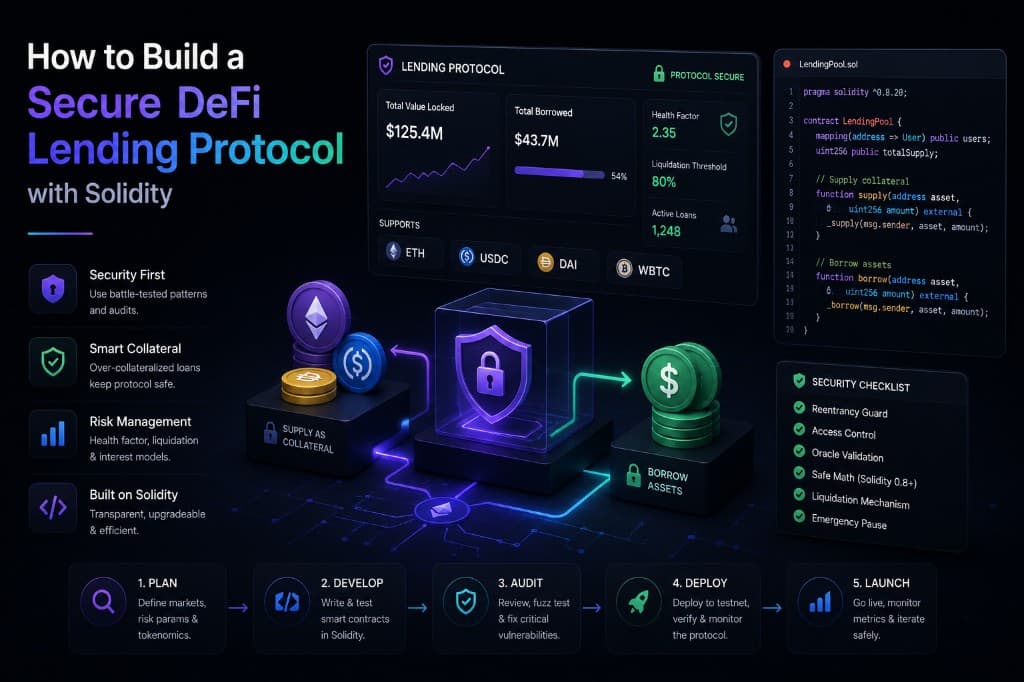
A hands-on walkthrough of building a secure, auditable lending protocol — covering reentrancy guards, oracle risk, liquidations, and gas optimisation.
Protocol primitives first
A lending protocol is not a single contract — it is a system of collateral accounting, interest accrual, liquidations, and oracle reads. Before writing Solidity, define the economic model: which assets, how interest compounds, what collateral factors apply, and who can pause markets.
We start with immutable math libraries and isolated market contracts rather than a monolithic god-contract. Isolation limits blast radius when a single asset feed misbehaves. It also makes audits tractable because reviewers can reason about one market at a time.
Reentrancy and state hygiene
Every external call is a trust boundary. Follow checks-effects-interactions religiously, and use reentrancy guards on functions that move value or update critical accounting. Do not assume ERC-20 tokens behave politely — fee-on-transfer and rebasing tokens break naive balance maths.
Write invariant tests that run after every state-changing operation: total debt equals sum of positions, collateral never goes negative, and paused markets reject new borrows. Fuzzing with Foundry regularly finds edge cases manual review misses.
Oracle risk is protocol risk
Price feeds are the silent failure mode of DeFi. Design for stale prices, circuit breakers, and secondary oracles. A lending market that liquidates on a manipulated spot price will destroy user trust faster than any UI bug.
We prefer time-weighted or mediated feeds with heartbeat checks. When an oracle is stale, freeze new borrows and liquidations that depend on that price rather than inventing a fallback number. Explicit failure beats silent insolvency.
Gas, upgrades, and audit readiness
Gas optimisation should follow correctness. Pack storage carefully, cache storage reads, and avoid unbounded loops over user lists. For upgrades, prefer transparent patterns with timelocked admin powers and clear storage layouts.
Ship with a public test suite, threat model document, and known limitations list before external audit. Auditors move faster — and catch more — when you have already eliminated the obvious classes of bugs.
Liquidations that remain solvent
Liquidation design determines whether the protocol survives volatility. Incentives must be high enough for liquidators to act, but not so aggressive that healthy positions get clipped on transient wicks.
Simulate cascading liquidations under historical stress scenarios. If your model only works in calm markets, it is not ready for mainnet capital.
Model adverse market conditions
Protocol work requires a written threat model before it requires clever Solidity. Name the assets at risk, privileged roles, external calls, oracle assumptions, economic incentives, and the conditions under which the protocol should pause. Model honest and malicious actors separately, including users who combine transactions in ways the interface never presents. Talha, our CTO, treats that document as an engineering artifact that guides design, tests, and audit review. The goal is not to claim a contract is invulnerable; it is to make every accepted risk explicit, bounded, and observable before real capital is exposed.
Constrain governance and upgrades
Use layers of evidence for safety. Unit tests establish expected behavior; fuzzing searches unusual inputs; invariant tests verify accounting across arbitrary sequences; and fork or integration tests exercise the real dependencies the deployment will touch. Review upgrades, role changes, and emergency controls as carefully as public functions because governance can be the largest attack surface. Simulate failed oracle updates, unusual token behavior, liquidity stress, and transaction reordering. Security findings should result in a test or invariant whenever possible, so the codebase retains the lesson after an audit report is closed.
Security is a continuing operational practice, not a property conferred by deployment or an external audit. Write down the assets, roles, external calls, oracle dependencies, economic assumptions, and pause conditions the protocol accepts. Turn the most important claims into invariant, fuzz, integration, and adversarial tests, especially around accounting, unusual token behavior, and transaction ordering. Review administrators, upgrades, multisig ownership, timelocks, and emergency controls as part of the same threat surface as public functions. Before mainnet, prepare a rehearsable runbook covering bytecode verification, parameters, monitoring thresholds, incident communication, and a conservative launch boundary such as caps or staged access. Maintain a record of accepted risks and close every finding with evidence. That rigor makes a blockchain capability useful alongside the web, mobile, and AI products that still need secure, dependable delivery.
Protocol teams should also practice decision hygiene around economics. Record the source of each collateral factor, fee, threshold, and liquidation incentive, plus the condition that would justify changing it. Run scenarios using adverse historical moves and plausible liquidity gaps, then expose the monitoring signals that would reveal stress early. Separate emergency action from routine governance with clear authority and time delay, and communicate those limits to users honestly. Do not broaden supported assets or privileges simply to meet a launch date when the monitoring or test evidence is incomplete. Conservative scope, transparent assumptions, and rehearsed operations are often the highest-leverage security controls available before a protocol has a long operational history.
Audit only after invariants pass
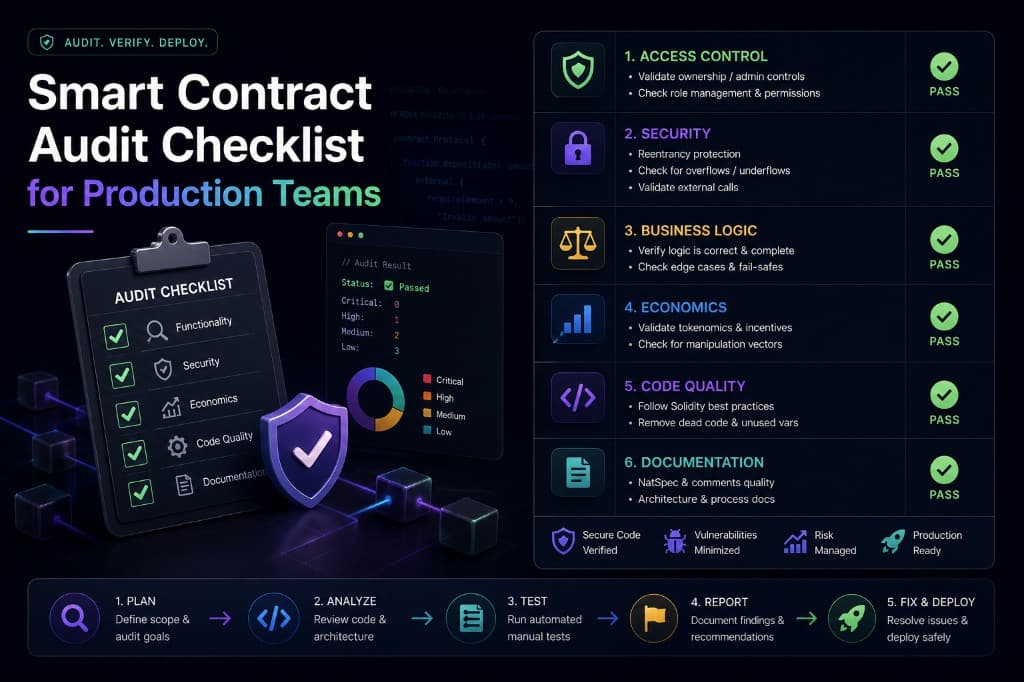
Do not spend external audit budget until Foundry fuzzing, invariant tests, and an internal threat model are green. Auditors catch more when obvious classes of bugs are already gone.
A Solidity DeFi protocol is ready for review when economic assumptions and oracle failure modes are written down honestly.
“Sustainable delivery comes from making the important trade-offs explicit, measurable, and recoverable.”
Checklist
- Threat model and privileged roles enumerated
- Invariant and fuzz tests cover critical accounting
- Oracle and external dependency failures simulated
- Upgrade, pause, and recovery controls reviewed
- Deployment ownership and timelocks verified
- Audit findings closed with evidence and tests
Muhammad Talha Zubair
CTO & Managing Director
Owns technical direction and delivery across web, mobile, and AI integration work. Sets architecture standards and keeps product engineering close to the builders.


Let's build something
remarkable
Whether you need a web or mobile app with AI integrations, blockchain work, or a conversation about our AI products — tell us what you're building and we'll respond fast.
Blog questions
How we write, how often we publish, and how you can contribute or stay in the loop.
Blogs are written by Automative Tech’s engineering leadership — Muhammad Talha Zubair, Bilal Hassan, and Umar Khalid — based on production web, mobile, AI integration, and blockchain work.
We lead with custom web and mobile delivery with AI integrations — Next.js, React, React Native, Flutter, and LLM features. Selected posts also cover blockchain, AI products, and cloud when they support shipping real products.
A few deep pieces per month. We prioritize substance over cadence.
Yes with attribution and a link back to the original. For syndication, contact us for a simple agreement.
Occasionally, when the author has real production experience. Pitch a short outline via the contact form.
Follow the social links in the footer, or contact us to ask about engineering notes updates.