Smart Contract Audit Checklist for Production Teams

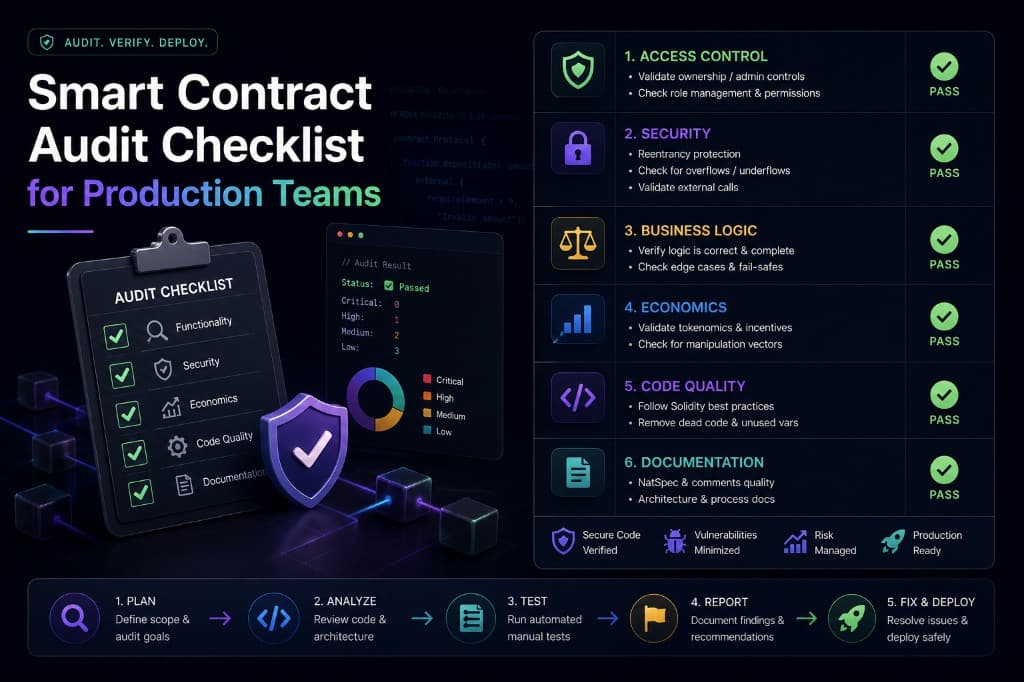
Before any external audit, run this internal pass — covering access control, economic exploits, oracle assumptions, and upgrade safety.
Why internal passes come first
External auditors are expensive and finite. Sending them a codebase full of missing access modifiers wastes their time and your budget. Our internal checklist removes entire vulnerability classes before the first kickoff call.
It also creates shared language between protocol engineers and security reviewers so findings map to known categories instead of vague unease.
Access control and privilege edges
Enumerate every privileged function: upgrades, pauses, parameter changes, oracle setters, and rescue methods. Confirm least privilege, timelocks where appropriate, and no leftover debug backdoors.
Check initialisation patterns on proxies. Uninitialised implementations and front-runnable initialisers still appear in otherwise mature codebases.
Economic and oracle exploits
Model flash-loanable markets, donation attacks, and rounding asymmetries. Ask whether an attacker can force insolvency or extract value by manipulating a single external call.
Oracle assumptions deserve their own threat section. Stale prices, spot manipulation, and decimal mismatches are recurring root causes.
Upgrade and operational safety
Review storage layouts, upgrade authority, and emergency procedures. A perfect contract with an unsafe admin key is not secure.
Ship the checklist results with the audit package: known risks, test coverage maps, and invariant suites. Auditors catch more when you have already been honest about what worries you.
Checklist items we never skip
Reentrancy on value movement, CEI compliance, ERC-20 oddities, signature replay, and block.timestamp dependence all get explicit yes/no review. Ambiguous answers become tickets before mainnet.
Treat the checklist as living documentation. Every incident or near-miss adds a row so the organisation compounds security learning.
Write a protocol threat model
Protocol work requires a written threat model before it requires clever Solidity. Name the assets at risk, privileged roles, external calls, oracle assumptions, economic incentives, and the conditions under which the protocol should pause. Model honest and malicious actors separately, including users who combine transactions in ways the interface never presents. Talha, our CTO, treats that document as an engineering artifact that guides design, tests, and audit review. The goal is not to claim a contract is invulnerable; it is to make every accepted risk explicit, bounded, and observable before real capital is exposed.
Test invariants and hostile inputs
Use layers of evidence for safety. Unit tests establish expected behavior; fuzzing searches unusual inputs; invariant tests verify accounting across arbitrary sequences; and fork or integration tests exercise the real dependencies the deployment will touch. Review upgrades, role changes, and emergency controls as carefully as public functions because governance can be the largest attack surface. Simulate failed oracle updates, unusual token behavior, liquidity stress, and transaction reordering. Security findings should result in a test or invariant whenever possible, so the codebase retains the lesson after an audit report is closed.
Security is a continuing operational practice, not a property conferred by deployment or an external audit. Write down the assets, roles, external calls, oracle dependencies, economic assumptions, and pause conditions the protocol accepts. Turn the most important claims into invariant, fuzz, integration, and adversarial tests, especially around accounting, unusual token behavior, and transaction ordering. Review administrators, upgrades, multisig ownership, timelocks, and emergency controls as part of the same threat surface as public functions. Before mainnet, prepare a rehearsable runbook covering bytecode verification, parameters, monitoring thresholds, incident communication, and a conservative launch boundary such as caps or staged access. Maintain a record of accepted risks and close every finding with evidence. That rigor makes a blockchain capability useful alongside the web, mobile, and AI products that still need secure, dependable delivery.
Protocol teams should also practice decision hygiene around economics. Record the source of each collateral factor, fee, threshold, and liquidation incentive, plus the condition that would justify changing it. Run scenarios using adverse historical moves and plausible liquidity gaps, then expose the monitoring signals that would reveal stress early. Separate emergency action from routine governance with clear authority and time delay, and communicate those limits to users honestly. Do not broaden supported assets or privileges simply to meet a launch date when the monitoring or test evidence is incomplete. Conservative scope, transparent assumptions, and rehearsed operations are often the highest-leverage security controls available before a protocol has a long operational history.
Finally, make this practice part of the normal delivery cadence rather than a document opened only during an incident or launch. Assign a clear owner, review the evidence after meaningful changes, and turn any recurring surprise into a visible test, metric, or runbook step. The right level of process is the smallest one that helps the team make a safer decision quickly. That balance keeps product momentum high while giving customers a dependable web, mobile, or integrated experience as the system and its users grow.
Before launch, have an engineer who did not write the change walk through the threat model, deployment controls, and recovery sequence. Independent review makes implicit assumptions visible before they become irreversible on-chain risk.
Ship the checklist with the audit package
Include known risks, coverage maps, and invariant suites with the external audit kickoff. Ambiguous checklist answers become tickets before mainnet.
Internal passes first — then auditors — is how production teams protect both users and budget.
“Sustainable delivery comes from making the important trade-offs explicit, measurable, and recoverable.”
Checklist
- Threat model and privileged roles enumerated
- Invariant and fuzz tests cover critical accounting
- Oracle and external dependency failures simulated
- Upgrade, pause, and recovery controls reviewed
- Deployment ownership and timelocks verified
- Audit findings closed with evidence and tests
Muhammad Talha Zubair
CTO & Managing Director
Owns technical direction and delivery across web, mobile, and AI integration work. Sets architecture standards and keeps product engineering close to the builders.


Let's build something
remarkable
Whether you need a web or mobile app with AI integrations, blockchain work, or a conversation about our AI products — tell us what you're building and we'll respond fast.
Blog questions
How we write, how often we publish, and how you can contribute or stay in the loop.
Blogs are written by Automative Tech’s engineering leadership — Muhammad Talha Zubair, Bilal Hassan, and Umar Khalid — based on production web, mobile, AI integration, and blockchain work.
We lead with custom web and mobile delivery with AI integrations — Next.js, React, React Native, Flutter, and LLM features. Selected posts also cover blockchain, AI products, and cloud when they support shipping real products.
A few deep pieces per month. We prioritize substance over cadence.
Yes with attribution and a link back to the original. For syndication, contact us for a simple agreement.
Occasionally, when the author has real production experience. Pitch a short outline via the contact form.
Follow the social links in the footer, or contact us to ask about engineering notes updates.