Edge Computing for Global Web Apps: When It Actually Pays Off

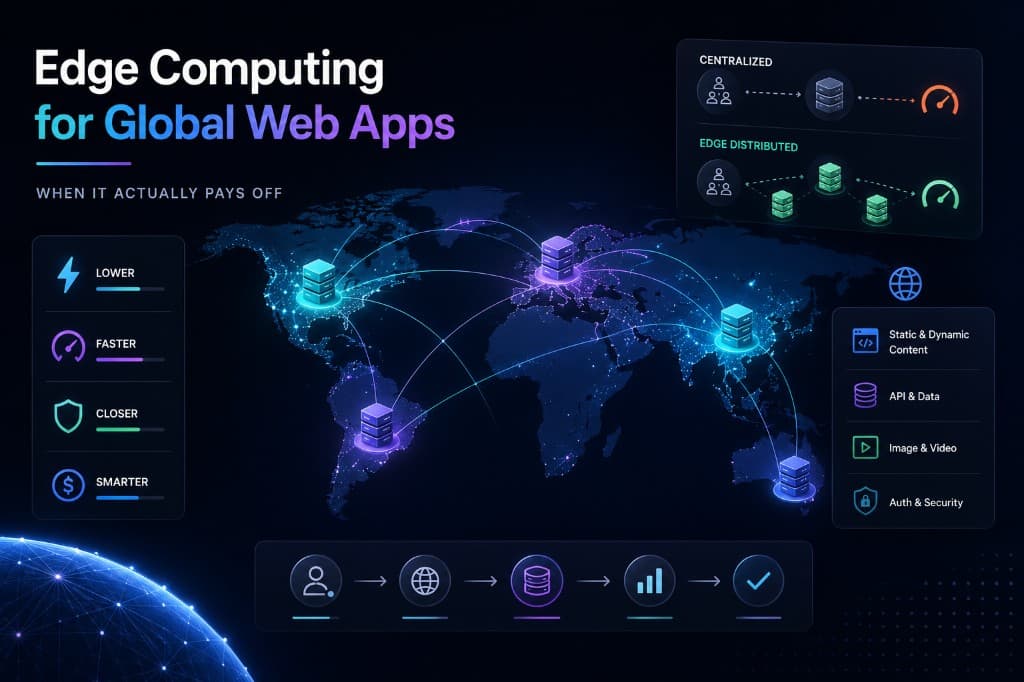
When to push logic to the edge, when to keep it in region, and the consistency trade-offs to document up front for global products.
Edge is a latency tool, not a architecture religion
Pushing everything to the edge creates consistency headaches and debugging fog. Push the right things: static assets, personalisation that tolerates slight staleness, auth checks, and A/B routing.
Keep strongly consistent writes and complex transactions in regional systems of record. Document that split early so product expectations match physics.
Write the consistency appendix in the architecture review: cached data, TTLs, and invalidation owners. Without it, product and support invent conflicting expectations.
What belongs at the edge
HTML shell rendering, bot mitigation, geo-routing, and cacheable API fragments are high-ROI. Heavy business logic with multi-row transactions usually is not.
Measure TTFB from real user regions before and after. Edge wins that only appear in a single synthetic probe are marketing, not engineering.
Write the consistency appendix in the architecture review: cached data, TTLs, and invalidation owners. Without it, product and support invent conflicting expectations.
Consistency trade-offs to write down
Stale-while-revalidate, session affinity, and conflict windows should be explicit. Users in Sydney and Frankfurt will not see the same read-after-write behaviour unless you design for it.
We include a consistency appendix in architecture reviews: which data is edge-cached, TTLs, and invalidation paths.
Write the consistency appendix in the architecture review: cached data, TTLs, and invalidation owners. Without it, product and support invent conflicting expectations.
Operational realities
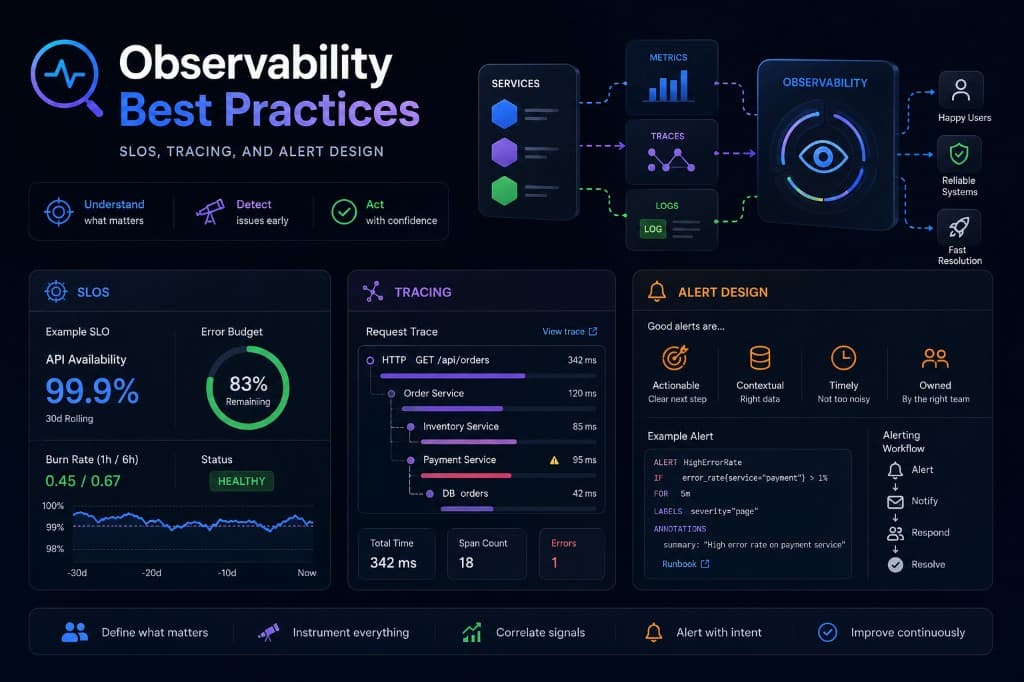
Edge platforms constrain runtime, memory, and dependencies. Observability must stitch edge traces to origin traces or incidents become two half-stories.
Start with one high-traffic read path. Expand only after you have kill switches and clear ownership for cache poison and config rollout failures.
Write the consistency appendix in the architecture review: cached data, TTLs, and invalidation owners. Without it, product and support invent conflicting expectations.
Expand edge only with kill switches
Start with one high-traffic read path. Expand edge logic only after you have cache-poison kill switches, clear ownership, and traces that stitch edge to origin.
Edge computing pays off when latency wins are measured from real user regions — not a single synthetic probe.
Write the consistency appendix in the architecture review: cached data, TTLs, and invalidation owners. Without it, product and support invent conflicting expectations.
Push only work that tolerates physics
Push static assets, lightly stale personalisation, auth checks, and A/B routing to the edge. Keep strongly consistent writes and multi-row transactions in regional systems of record.
Document the split early so product expectations match physics: Sydney and Frankfurt will not see identical read-after-write behaviour unless you design for it.
Write the consistency appendix in the architecture review: cached data, TTLs, and invalidation owners. Without it, product and support invent conflicting expectations.
Measure TTFB from real user regions
Edge wins that only appear in a single synthetic probe are marketing. Compare real-user TTFB before and after from the regions that motivated the investment.
HTML shells, bot mitigation, geo-routing, and cacheable API fragments are high-ROI. Heavy business logic usually is not.
Write the consistency appendix in the architecture review: cached data, TTLs, and invalidation owners. Without it, product and support invent conflicting expectations.
Stitch edge and origin traces
Edge platforms constrain runtime and dependencies. Observability must connect edge spans to origin spans or incidents become two half-stories.
Start with one read path, kill switches for cache poison, and clear ownership for config rollouts.
Write the consistency appendix in the architecture review: cached data, TTLs, and invalidation owners. Without it, product and support invent conflicting expectations.
“Sustainable delivery comes from making the important trade-offs explicit, measurable, and recoverable.”
Checklist
- Service promise and recovery objective documented
- Tenant or workload boundaries visible in telemetry
- Failure and rollback exercise completed
- Consistency and cache invalidation rules recorded
- Cost and operational owner assigned
- Runbook tested before wider rollout
Umar Khalid
Software Engineering Manager
Manages day-to-day software engineering across APIs, web UI, and AI features — focused on reliable, maintainable production systems clients can own.
Let's build something
remarkable
Whether you need a web or mobile app with AI integrations, blockchain work, or a conversation about our AI products — tell us what you're building and we'll respond fast.
Blog questions
How we write, how often we publish, and how you can contribute or stay in the loop.
Blogs are written by Automative Tech’s engineering leadership — Muhammad Talha Zubair, Bilal Hassan, and Umar Khalid — based on production web, mobile, AI integration, and blockchain work.
We lead with custom web and mobile delivery with AI integrations — Next.js, React, React Native, Flutter, and LLM features. Selected posts also cover blockchain, AI products, and cloud when they support shipping real products.
A few deep pieces per month. We prioritize substance over cadence.
Yes with attribution and a link back to the original. For syndication, contact us for a simple agreement.
Occasionally, when the author has real production experience. Pitch a short outline via the contact form.
Follow the social links in the footer, or contact us to ask about engineering notes updates.