Kubernetes vs ECS: Which Container Platform Should Your Team Choose?

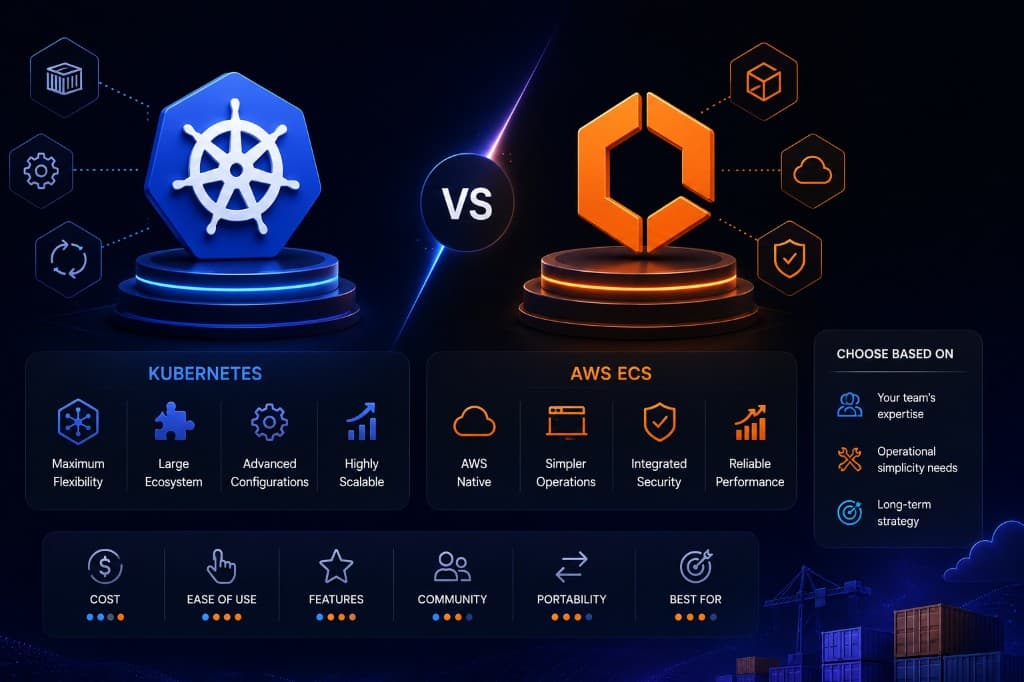
A pragmatic comparison of Kubernetes vs AWS ECS based on team size, budget, operational burden, and when each option fits a product team shipping on AWS.
The question is not which is better
Kubernetes versus ECS debates often pretend there is a universal winner. In production, the winning choice is the one your team can operate safely at 2 a.m. For a five-person product team on AWS, that is frequently ECS. For a platform group standardising across clouds and dozens of services, Kubernetes earns its complexity.
We evaluate orchestration through three constraints: people, failure modes, and cost of change. If your roadmap includes multi-cloud portability, custom controllers, or advanced scheduling, Kubernetes is usually the right investment. If you need reliable deploys on AWS with minimal platform engineering, ECS Fargate removes entire classes of node management.
Write down who is on-call for the platform layer before you adopt it. Orchestration without an owner is an unpaid product tax.
Operational burden in practice
Kubernetes gives you unmatched flexibility — and an endless surface of YAML, RBAC, CNI, and upgrade chores. Even with EKS, someone owns cluster upgrades, addon compatibility, and capacity planning for the control plane adjacent components.
ECS reduces that surface. Task definitions, services, and capacity providers cover most web and worker workloads. The trade-off is expressiveness: sidecars, sophisticated traffic shaping, and portable GitOps patterns are more natural in Kubernetes. Teams without a platform mandate often overpay in cognitive load for features they never use.
Write down who is on-call for the platform layer before you adopt it. Orchestration without an owner is an unpaid product tax.
Cost and performance observations
On comparable web services, we see Fargate and well-tuned Kubernetes node pools deliver similar p50 latency. Differences appear in burst scaling and packing efficiency. Kubernetes bin-packing can be more efficient for mixed workloads when you invest in autoscaling and rightsizing. ECS Spot capacity providers are excellent for interruptible workers.
Control-plane and observability costs matter too. A small EKS estate plus logging agents can exceed ECS spend before application traffic is large. Benchmark your actual services — chatty gRPC meshes behave differently than simple HTTP APIs.
Write down who is on-call for the platform layer before you adopt it. Orchestration without an owner is an unpaid product tax.
A decision framework for 2025
Choose ECS when you are AWS-centric, your team is product-focused, and workloads are mostly containers with standard networking. Choose Kubernetes when you need portable platform abstractions, custom operators, or multi-environment parity that AWS-native APIs cannot express cleanly.
Hybrid is valid: ECS for customer-facing APIs, Kubernetes for data or ML pipelines. What fails is choosing Kubernetes because it is fashionable, then starving the platform team that must keep it healthy.
Write down who is on-call for the platform layer before you adopt it. Orchestration without an owner is an unpaid product tax.
Choose what you can operate at 2 a.m.
Pick ECS when an AWS-centric product team needs reliable containers with low platform overhead. Pick Kubernetes when you can fund the expertise for portable platforms and custom operators.
Fashionable orchestration without an owner is how cloud costs rise while delivery slows.
Write down who is on-call for the platform layer before you adopt it. Orchestration without an owner is an unpaid product tax.
Compare operational burden, not feature lists
Kubernetes gives flexibility and an endless surface of YAML, RBAC, CNI, and upgrades. Even with EKS, someone owns cluster lifecycle and addon compatibility.
ECS reduces that surface with task definitions and capacity providers. The trade-off is expressiveness: custom controllers and portable GitOps patterns are more natural in Kubernetes.
Write down who is on-call for the platform layer before you adopt it. Orchestration without an owner is an unpaid product tax.
Benchmark your actual services
On comparable web services, Fargate and well-tuned node pools can deliver similar p50 latency. Differences appear in burst scaling and packing efficiency.
Control-plane and observability costs matter too. A small EKS estate plus agents can exceed ECS spend before application traffic is large.
Write down who is on-call for the platform layer before you adopt it. Orchestration without an owner is an unpaid product tax.
Hybrid is allowed — fashion is not
ECS for customer-facing APIs and Kubernetes for data or ML pipelines can be a rational split. What fails is choosing Kubernetes because it is fashionable, then starving the platform team that must keep it healthy.
Write down who is on-call for the platform layer before you adopt it. Orchestration without an owner is an unpaid product tax.
“Sustainable delivery comes from making the important trade-offs explicit, measurable, and recoverable.”
Checklist
- Service promise and recovery objective documented
- Tenant or workload boundaries visible in telemetry
- Failure and rollback exercise completed
- Consistency and cache invalidation rules recorded
- Cost and operational owner assigned
- Runbook tested before wider rollout
Umar Khalid
Software Engineering Manager
Manages day-to-day software engineering across APIs, web UI, and AI features — focused on reliable, maintainable production systems clients can own.
Let's build something
remarkable
Whether you need a web or mobile app with AI integrations, blockchain work, or a conversation about our AI products — tell us what you're building and we'll respond fast.
Blog questions
How we write, how often we publish, and how you can contribute or stay in the loop.
Blogs are written by Automative Tech’s engineering leadership — Muhammad Talha Zubair, Bilal Hassan, and Umar Khalid — based on production web, mobile, AI integration, and blockchain work.
We lead with custom web and mobile delivery with AI integrations — Next.js, React, React Native, Flutter, and LLM features. Selected posts also cover blockchain, AI products, and cloud when they support shipping real products.
A few deep pieces per month. We prioritize substance over cadence.
Yes with attribution and a link back to the original. For syndication, contact us for a simple agreement.
Occasionally, when the author has real production experience. Pitch a short outline via the contact form.
Follow the social links in the footer, or contact us to ask about engineering notes updates.