Observability Best Practices: SLOs, Tracing, and Alert Design

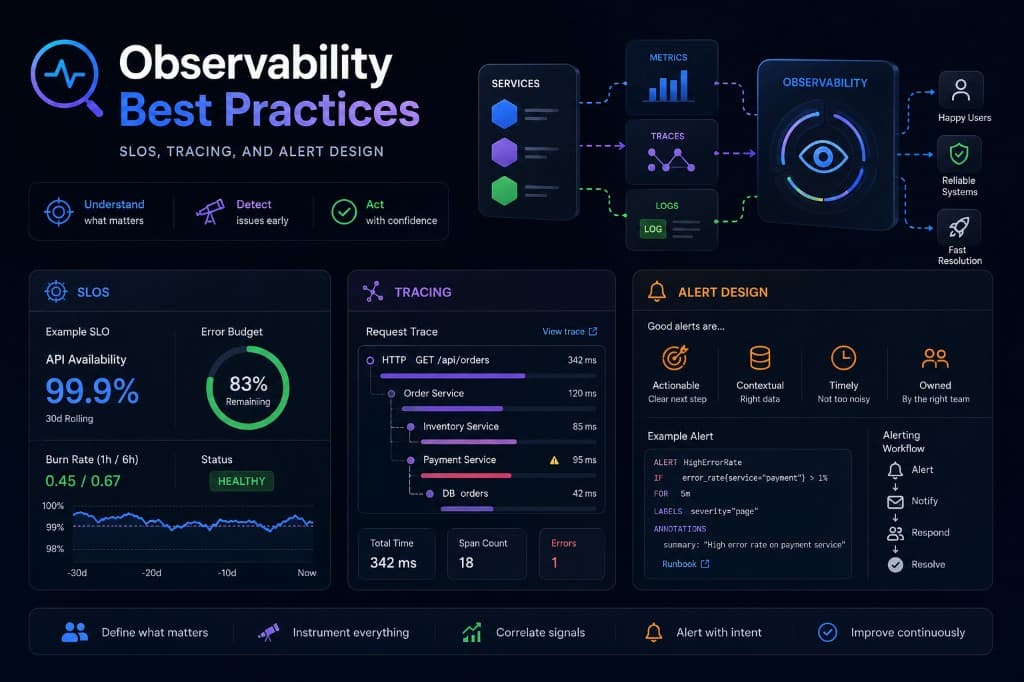
SLOs, tracing sampling, and alert design that reduce noise while cutting mean time to recovery on real production incidents.
Cost without questions is waste
Observability spend balloons when every service logs at debug and traces at 100%. The question is not whether you have dashboards — it is whether those signals shorten incidents enough to justify the bill.
We tie instrumentation investment to user-facing SLOs. If a metric never informs a decision or alert, it is a candidate for deletion.
During incident reviews, ask which signal actually shortened recovery. Keep funding those; sunset the rest.
SLOs that drive behaviour
Pick a few latency and availability SLOs customers would recognise. Error budgets create permission to move fast and a forcing function to stop when reliability debt accumulates.
Alert on symptoms users feel, not on every disk spike. Page-worthy alerts should be rare, actionable, and tied to runbooks.
During incident reviews, ask which signal actually shortened recovery. Keep funding those; sunset the rest.
Tracing with intentional sampling
OpenTelemetry everywhere, sample intelligently. Keep head sampling high for rare error classes and critical paths; reduce volume on chatty success traffic.
Exemplars that link metrics to traces turn "p99 is high" into a specific slow dependency within minutes.
During incident reviews, ask which signal actually shortened recovery. Keep funding those; sunset the rest.
Noise reduction as an engineering goal
Track alert volume and acknowledge rates. If on-call ignores a class of alerts, fix the signal — do not hire people to endure it.
Observability that pays for itself shows up as lower MTTR and fewer repeat incidents, not as a prettier flame graph.
During incident reviews, ask which signal actually shortened recovery. Keep funding those; sunset the rest.
Delete signals that never decide
Quarterly, remove metrics and traces that never informed an alert or incident decision. Observability spend should buy lower MTTR, not prettier unused dashboards.
Tie instrumentation to a few customer-recognisable SLOs and page only on symptoms users feel.
During incident reviews, ask which signal actually shortened recovery. Keep funding those; sunset the rest.
Alert on user symptoms, not every spike
Pick a few latency and availability SLOs customers would recognise. Error budgets create permission to move fast and a forcing function to stop when reliability debt accumulates.
Page-worthy alerts should be rare, actionable, and tied to runbooks. If on-call ignores a class of alerts, fix the signal.
During incident reviews, ask which signal actually shortened recovery. Keep funding those; sunset the rest.
Sample traces with intent
OpenTelemetry everywhere, sample intelligently. Keep higher sampling for errors and critical paths; reduce volume on chatty success traffic.
Exemplars that link metrics to traces turn “p99 is high” into a specific slow dependency within minutes.
During incident reviews, ask which signal actually shortened recovery. Keep funding those; sunset the rest.
Track alert volume as an engineering metric
Watch acknowledge rates and noise. Observability that pays for itself shows up as lower MTTR and fewer repeat incidents — not as a prettier flame graph nobody opens.
During incident reviews, ask which signal actually shortened recovery. Keep funding those; sunset the rest.
“Sustainable delivery comes from making the important trade-offs explicit, measurable, and recoverable.”
Checklist
- Service promise and recovery objective documented
- Tenant or workload boundaries visible in telemetry
- Failure and rollback exercise completed
- Consistency and cache invalidation rules recorded
- Cost and operational owner assigned
- Runbook tested before wider rollout
Umar Khalid
Software Engineering Manager
Manages day-to-day software engineering across APIs, web UI, and AI features — focused on reliable, maintainable production systems clients can own.
Let's build something
remarkable
Whether you need a web or mobile app with AI integrations, blockchain work, or a conversation about our AI products — tell us what you're building and we'll respond fast.
Blog questions
How we write, how often we publish, and how you can contribute or stay in the loop.
Blogs are written by Automative Tech’s engineering leadership — Muhammad Talha Zubair, Bilal Hassan, and Umar Khalid — based on production web, mobile, AI integration, and blockchain work.
We lead with custom web and mobile delivery with AI integrations — Next.js, React, React Native, Flutter, and LLM features. Selected posts also cover blockchain, AI products, and cloud when they support shipping real products.
A few deep pieces per month. We prioritize substance over cadence.
Yes with attribution and a link back to the original. For syndication, contact us for a simple agreement.
Occasionally, when the author has real production experience. Pitch a short outline via the contact form.
Follow the social links in the footer, or contact us to ask about engineering notes updates.