React Native vs Flutter for Startup Mobile Apps: How to Choose in 2026

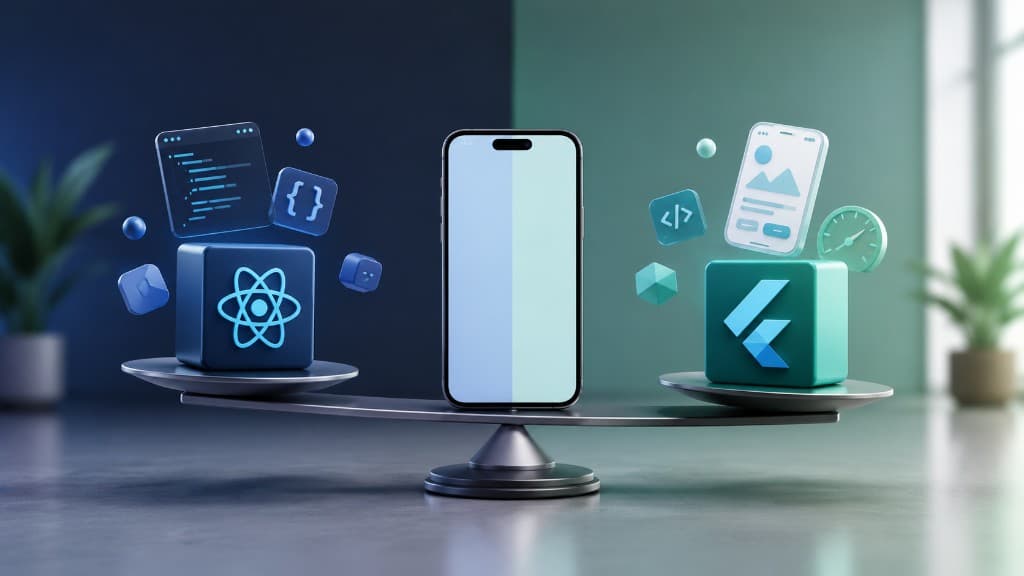
A founder-friendly comparison of React Native and Flutter for startup mobile app development — team skills, native modules, hiring, performance, and long-term ownership.
What startups actually optimize for
Startups rarely need two fully separate native teams on day one. They need a credible iOS and Android product, a shared codebase they can hire for, and a path to native modules when the product demands them.
React Native and Flutter are both production-viable for custom mobile app development. The wrong choice is usually driven by blog hype — not by team skills, App Store constraints, or how many platform-specific features you already know you need in year one.
As CTO at Automative Tech, I evaluate this decision through delivery risk: which stack your team can operate after launch, how fast you can ship the first release, and whether web talent can contribute without a second hiring funnel.
Revisit the stack choice when hiring markets or native roadmap intensity change — not when a conference talk declares a new winner.
When React Native is the better default
React Native is a strong default when your web product is already React and TypeScript and you want overlapping mental models across web and mobile. Shared design tokens, form validation, and domain types travel well between surfaces.
It also helps when you expect deep native integrations and want an ecosystem that drops to Swift or Kotlin without abandoning the rest of the app. Expo accelerates early delivery; custom native work remains available when you outgrow the defaults.
If you plan to hire full-stack engineers who already know React, React Native usually reduces ramp time and keeps your mobile app development partner aligned with your web roadmap.
Revisit the stack choice when hiring markets or native roadmap intensity change — not when a conference talk declares a new winner.
When Flutter is the better default
Flutter shines when UI consistency and pixel control matter more than sharing a React mental model, or when the team already knows Dart and wants a single rendering pipeline across platforms.
It can be the better call for highly branded, animation-heavy clients where you want fewer bridge surprises. Impeller and modern Flutter tooling have improved jank stories on iOS and Android for well-built apps.
The trade-off is hiring and knowledge transfer if the rest of your company lives in TypeScript. Flutter is excellent — just make sure ownership after launch matches the language bet.
Revisit the stack choice when hiring markets or native roadmap intensity change — not when a conference talk declares a new winner.
Performance, hiring, and native modules
Both stacks can feel native when lists, navigation, and images are built carefully. Profile on mid-tier Android devices and older iPhones before you declare a winner from a marketing demo.
Count custom native modules on the first-year roadmap: camera pipelines, Bluetooth, background location, payments edge cases. More native surface area means you need engineers comfortable outside the cross-platform layer.
Hiring depth still favors React in many markets. Flutter hiring is strong in some regions and thinner in others. Ask your partner who will maintain the app twelve months after launch.
Revisit the stack choice when hiring markets or native roadmap intensity change — not when a conference talk declares a new winner.
Decision checklist we use with clients
We ask four questions: What does the existing web stack look like? How many custom native modules are on the roadmap in the first year? Who will own the app after launch? What is the performance-sensitive journey (camera, maps, offline sync)?
Automative Tech ships both React Native and Flutter as a primary mobile service. We pick the runtime your team can operate — not the one that photographs better in a proposal.
If you are choosing a stack this quarter, run a one- or two-week spike with your real navigation and list patterns before locking a multi-year roadmap.
Revisit the stack choice when hiring markets or native roadmap intensity change — not when a conference talk declares a new winner.
Lock the stack only after a real spike
Before you commit for years, spike the riskiest journeys on mid-tier Android and an older iPhone: auth, lists, offline behaviour, and any native module you already know you need.
Automative Tech helps startups choose React Native or Flutter based on ownership and hiring reality — not social-media charts. The stack that survives that spike is the stack you can ship.
Revisit the stack choice when hiring markets or native roadmap intensity change — not when a conference talk declares a new winner.
Count year-one native modules honestly
Camera pipelines, Bluetooth, background location, and payment edge cases push you toward engineers who can work outside the cross-platform layer. Under-counting those modules is how “simple” apps become rewrite candidates.
If the roadmap is native-heavy and your company is React-fluent, React Native usually reduces coordination cost. If visual uniformity is the product, Flutter may still win — after a spike proves it.
Revisit the stack choice when hiring markets or native roadmap intensity change — not when a conference talk declares a new winner.
“The best cross-platform choice is the one your team can hire for, debug at 2 a.m., and extend without a rewrite.”
Checklist
- Web stack and shared TypeScript opportunity mapped
- Year-one native module list estimated
- Post-launch ownership and hiring plan named
- Mid-tier device performance spike completed
- Expo vs bare / Flutter tooling constraints reviewed
Muhammad Talha Zubair
CTO & Managing Director
Owns technical direction and delivery across web, mobile, and AI integration work. Sets architecture standards and keeps product engineering close to the builders.


Let's build something
remarkable
Whether you need a web or mobile app with AI integrations, blockchain work, or a conversation about our AI products — tell us what you're building and we'll respond fast.
Blog questions
How we write, how often we publish, and how you can contribute or stay in the loop.
Blogs are written by Automative Tech’s engineering leadership — Muhammad Talha Zubair, Bilal Hassan, and Umar Khalid — based on production web, mobile, AI integration, and blockchain work.
We lead with custom web and mobile delivery with AI integrations — Next.js, React, React Native, Flutter, and LLM features. Selected posts also cover blockchain, AI products, and cloud when they support shipping real products.
A few deep pieces per month. We prioritize substance over cadence.
Yes with attribution and a link back to the original. For syndication, contact us for a simple agreement.
Occasionally, when the author has real production experience. Pitch a short outline via the contact form.
Follow the social links in the footer, or contact us to ask about engineering notes updates.